AI literacy & verification
Use machine output critically, test its claims, decide when a tool belongs, and retain intellectual ownership.
A framework for the future of mathematics education
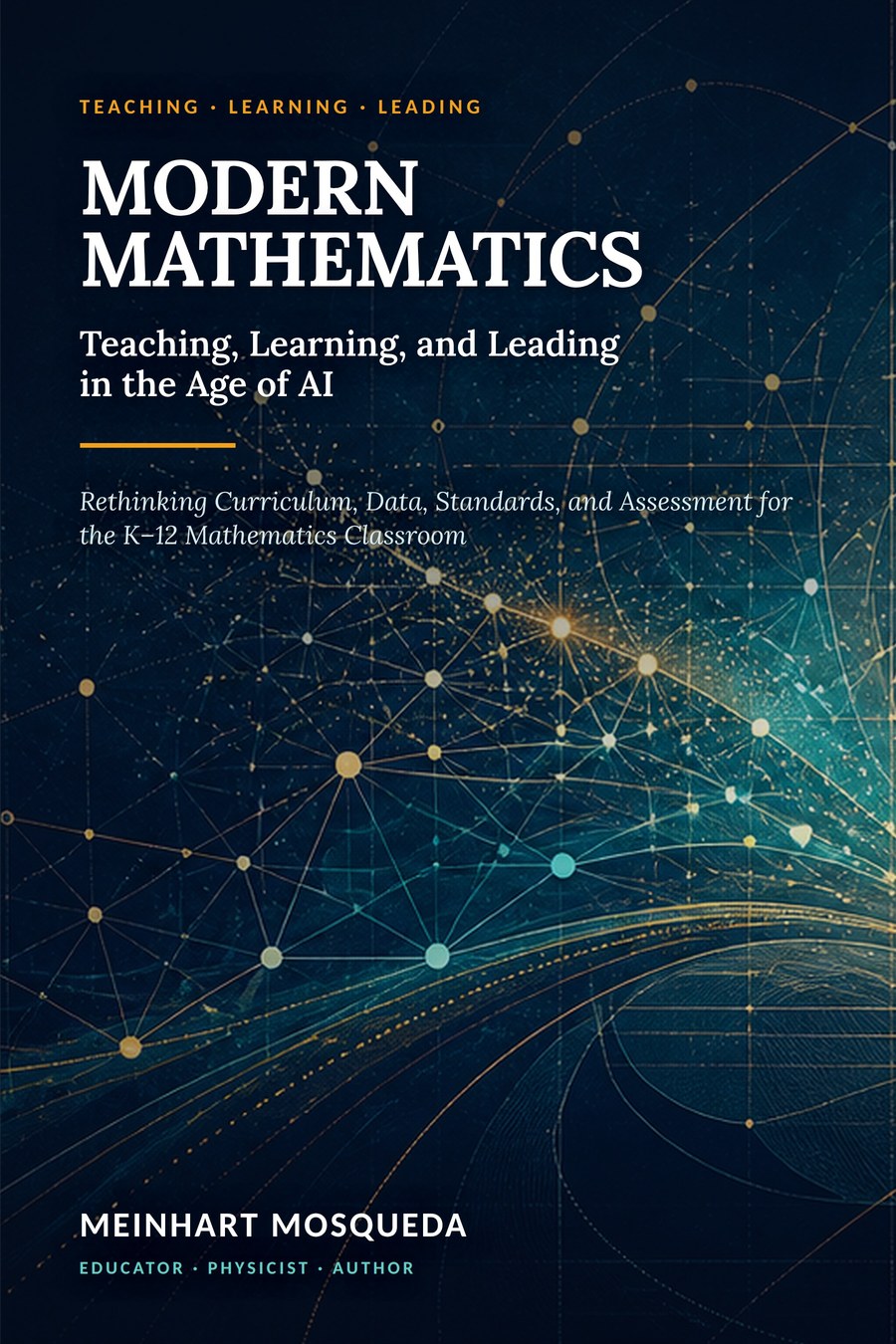
Rethinking Curriculum, Data, Standards, and Assessment for the K–12 Mathematics Classroom.
The central challenge
A student types a problem into an AI system and gets an answer in seconds. Sometimes it is right. Sometimes it is incomplete. Sometimes it is confidently wrong. Knowing the difference is now a mathematical skill—and it changes everything about what a mathematics education must do.
Modern Mathematics does not argue for less mathematics. It argues for mathematics held to a higher standard: students who can not only produce answers but judge them—asking what assumptions were made, what evidence supports the result, what uncertainty remains, and what human decision still has to be made once the computation is done.
The book calls that expanded capability mathematical agency—the ability to use mathematical knowledge, evidence, tools, and judgment to make and defend quantitative decisions.
Inside the framework
Systems respond to change by adding programs. The result is innovation without coherence. Modern Mathematics treats standards, curriculum, instruction, assessment, instructional materials, data, technology, AI, teacher expertise, pathways, equity, and governance as parts of one design.
Use machine output critically, test its claims, decide when a tool belongs, and retain intellectual ownership.
Reason with authentic evidence, variability, uncertainty, competing models, and defensible conclusions.
Distinguish polished output from genuine reasoning—and show what students can do independently.
Let high-quality instructional materials provide the spine that technology strengthens rather than fragments.
Explore the book
22 practical appendices
The framework at a glance, the seven principles of modern mathematics, and how to read the course frameworks.
Grade 6, Grade 7, Grade 8, Algebra I, Geometry, Algebra II, and Integrated Mathematics I, II, and III.
Performance task rubric, AI use and assessment matrix, student AI use disclosure, and lesson design template.
Curriculum review tool, opportunity-to-learn audit, governance scorecard, implementation roadmap, curriculum map, and graduate profile.
Who this book is for
Both an argument and a toolkit, Modern Mathematics is written for everyone with a hand on the system—from the classroom to the state capitol.
“The challenge facing mathematics education is no longer simply how to teach students to calculate. It is how to prepare them to reason, model, question, verify, and make responsible decisions in a world where machines can increasingly calculate for them.”

About the author
Meinhart Mosqueda—“Mike” to those who know him—has spent his career in the places where mathematics is actually put to work: the physics laboratory, the secondary classroom, and the rooms where state standards are written and instructional materials are judged.
He began in High Energy Physics, designing cosmic ray detectors and writing the computational models that turned raw signals into evidence, while teaching university physics. He then spent fifteen years teaching secondary mathematics, physics, chemistry, computer science, and robotics across three states. Today, as a statewide Education Specialist, he provides technical assistance and oversight for 6–12 mathematics programs and has helped lead the revision of statewide mathematics standards and the adoption of high-quality instructional materials.
He is a member of the Association of State Supervisors of Mathematics (ASSM), the National Council of Supervisors of Mathematics (NCSM), and the Mathematics Advisory Council of the Smarter Balanced Assessment Consortium.
Ed.S., Educational Leadership, University of Idaho · M.Ed., Educational Administration, Grand Canyon University · M.A., Secondary Education, West Virginia University · M.S. and B.S., Physics, Mindanao State University
Coming soon from SmartWorks Education
Paperback and eBook editions are on the way. Retail links will appear here as soon as publication details are final.